
What the Test Does
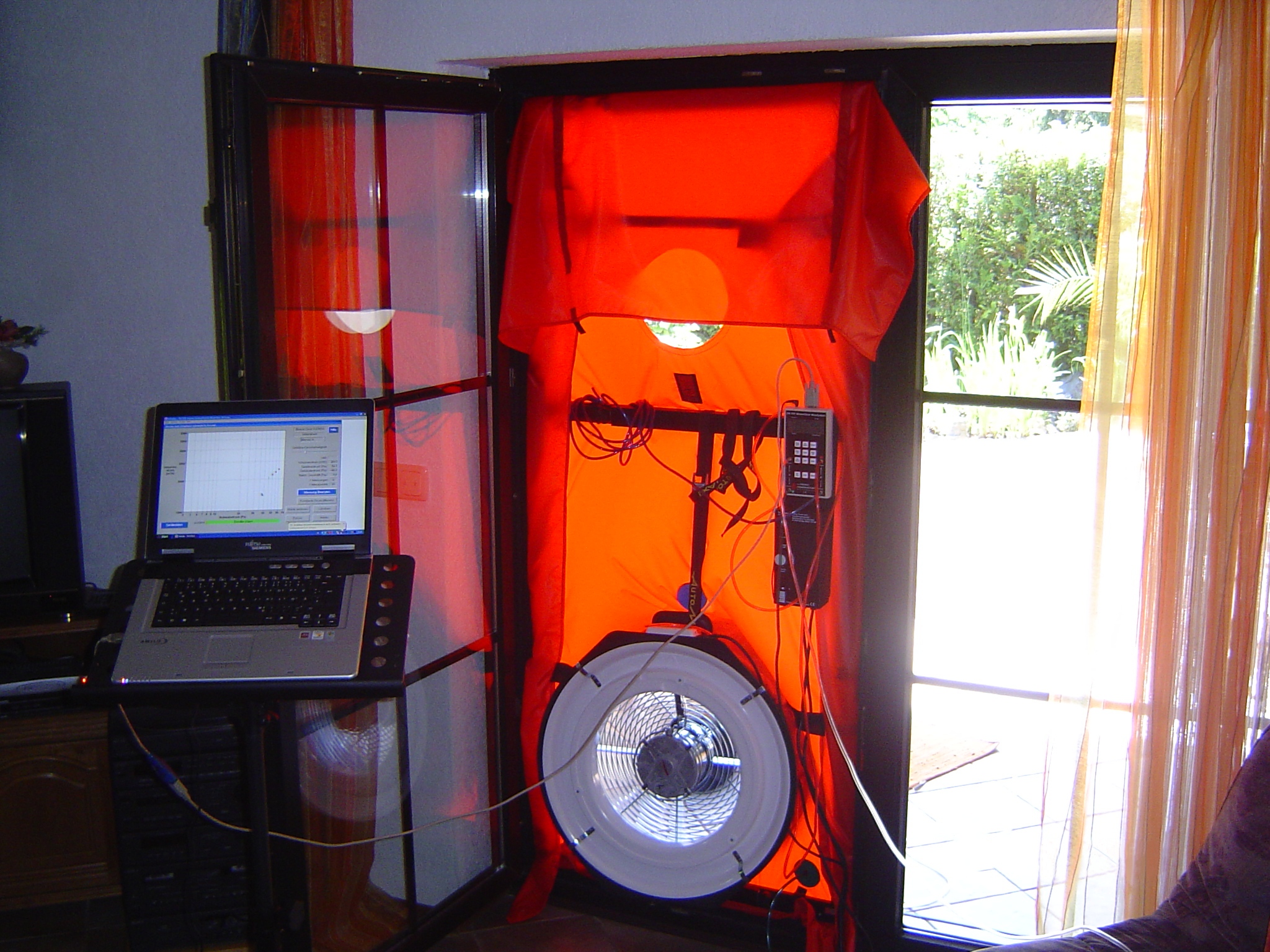
A blower door test depressurizes a building by installing a calibrated fan in an exterior door frame, sealing all intentional openings such as fireplace dampers and mechanical ventilation ports, and drawing air out of the building until a reference pressure differential of 50 pascals is maintained between indoors and outdoors. At that pressure, airflow through the fan is measured in cubic metres per hour or cubic feet per minute, depending on the instrument used.
The result is expressed as ACH50: air changes per hour at 50 pascals. It represents how many times per hour the entire air volume of the building is replaced by outside air when the envelope is subjected to that controlled pressure difference.
Test Procedure
The standard procedure follows CGSB 149.10, the Canadian method for determining the airtightness of building envelopes. Before the test begins, the technician:
- Closes all windows, exterior doors, and operable skylights
- Closes fireplace dampers and seals combustion air inlets
- Turns off exhaust fans and seals their terminations
- Opens all interior doors between conditioned spaces
- Measures the conditioned floor area and ceiling height to calculate building volume
The fan is mounted in the blower door frame and the pressure difference across the envelope is measured using a digital manometer. The technician ramps up fan speed through several pressure setpoints (typically 10 Pa to 70 Pa in depressurization mode, and optionally in pressurization mode as well). A fan curve is used to convert fan speed to actual airflow at each pressure level.
Calculating ACH50
Once the airflow at 50 Pa is determined by interpolation from the fan curve data, the ACH50 is calculated as:
ACH50 = Q50 / V
Where Q50 is the measured airflow in cubic metres per hour at 50 Pa, and V is the conditioned volume of the building in cubic metres. A house with a volume of 400 m³ and a measured Q50 of 2,000 m³/h would have an ACH50 of 5.0.
Interpreting Results in the Canadian Context
Canada's National Building Code 2020 sets a maximum of 3.0 ACH50 for new residential construction. This represents a significant tightening from earlier code editions. Many provinces have adopted this provision, though adoption timelines vary.
| Benchmark | ACH50 | Source |
|---|---|---|
| NBC 2020 maximum (new construction) | 3.0 | National Building Code of Canada 2020 |
| R-2000 standard | 1.5 | Natural Resources Canada |
| Passive House (PHPP) | 0.6 | Passive House Institute |
| Typical pre-1980 Canadian house | 6 – 12 | NRCan field data ranges |
| Typical 1980–2005 Canadian house | 3 – 7 | EnerGuide audit averages |
Using Results to Prioritize Work
A blower door result alone does not tell a contractor where the leaks are. It provides a quantified baseline. Locating the actual leakage paths requires a secondary technique, most commonly a combination of smoke pencil testing and infrared thermography conducted while the blower door holds the building at negative pressure.
Common high-priority leakage areas in Canadian residential construction include:
- Top-plate intersections and the attic floor perimeter
- Electrical boxes on exterior and party walls
- Plumbing penetrations through the air barrier
- Attic access hatches and pull-down stair assemblies
- Rim joist and band joist areas at the foundation
- Window and door rough openings behind the trim
Leak prioritization is typically based on the estimated contribution of each location to total leakage, and the practicality of accessing and sealing each area during the planned retrofit scope.
Limitations of the Test
The ACH50 metric normalises leakage by building volume, which means a larger building with the same total leakage area will show a lower ACH50 than a smaller one. For comparing buildings of very different sizes, some building scientists prefer the effective leakage area (ELA) or normalized leakage (NL) metrics.
The test is also a snapshot. It captures airtightness at the time of testing, under controlled conditions. Seasonal movement of wood framing, material aging, and settling can alter results over time. Testing before and after retrofit work is the standard practice to confirm that the intended air sealing was effective.