Material Selection Depends on Joint Type
Air sealing a building envelope involves bridging gaps, cracks, and penetrations that exist between different materials and assemblies. No single product is appropriate for every situation. The choice of sealing material depends on the width of the gap, the substrate materials on either side, whether the joint is subject to thermal or moisture-driven movement, expected service life, and whether the location will be accessible for future maintenance.
The four main categories used in Canadian residential construction are: adhesive tapes applied to sheathing and air barrier membranes; butyl or EPDM gaskets installed between framing members and plates; low-expansion polyurethane foam for penetrations and rough openings; and fluid-applied air barriers used as a continuous coating on sheathing. This article focuses on the first three, which are the most common in retrofit and new-construction air sealing work.
Peel-and-Stick Tapes
Adhesive tapes for air barriers fall into several chemical families. The most common in Canadian practice are:
Acrylic-Backed Tapes
Acrylic tapes are used on polyethylene air barrier membranes and on OSB or plywood sheathing when the sheathing itself serves as the air barrier plane. They perform well across the temperature range encountered during Canadian construction seasons and maintain adhesion through repeated freeze-thaw cycles if the substrate is clean and dry at application. Acrylic adhesives are typically rated for service temperatures from approximately -40°C to +80°C.
Application temperature matters. Most acrylic tapes require the substrate to be above a minimum temperature — commonly 5°C — at the time of application for the adhesive to bond correctly. Applying tape to cold or frost-affected sheathing and then expecting it to warm up does not produce an equivalent result to applying it at the correct temperature from the start.
Butyl-Backed Tapes
Butyl tapes have a more aggressive initial tack than acrylics and adhere well to a broader range of substrates, including concrete, wood, and some foil-faced rigid insulation boards. They are commonly used at penetrations where the air barrier membrane transitions around pipes, electrical conduits, or window frames. Butyl remains flexible at cold temperatures and does not become brittle, which makes it suitable for use on concrete foundation walls where temperature swings are moderated but the surface may be damp.
A limitation of butyl is that it tends to creep under sustained load or at elevated temperatures. On joints subject to differential movement, this can cause tape bridging to pull away from one substrate over time. For dynamic joints, a flexible sealant or a gasket may be more appropriate.
Tape Application Procedure
Proper application is as important as product selection. The substrate must be clean, dry, and free of dust or release agents. Tapes should be pressed firmly with a J-roller or similar tool to ensure full contact, particularly at edges. On OSB, the tape bridges surface roughness and must be pressed into all surface variations to prevent edge lifting. Corners and laps require extra care; the tape should be slit and folded rather than bunched, to avoid bridging gaps with a tent of tape that appears sealed but is not.
Gaskets
Gaskets are preformed sealing elements installed between two framing members or between a framing member and a substrate before fastening. They compress to fill the gap and form a continuous seal. They do not rely on adhesion to the substrate surface, which makes them useful in locations where tape adhesion is difficult to achieve or verify.
Sill Plate Gaskets
Compressible foam or EPDM gaskets are placed under sill plates before they are anchored to foundation walls or concrete slabs. This seals the gap that would otherwise exist between the bottom of the framing and the concrete surface. In Canadian construction, this joint is a common leakage point because concrete is rarely flat enough to allow a framing member to sit flush against it across its full length.
Top Plate and Electrical Box Gaskets
Foam gaskets are also used under electrical boxes on exterior walls and under the top plates of interior partition walls where they intersect the attic floor. Gaskets at electrical boxes are installed on the back of the box before it is set into the rough opening; they compress between the box and the vapour barrier or air barrier membrane behind the drywall.
Low-Expansion Polyurethane Foam
Gun-applied low-expansion polyurethane foam (commonly called "window and door foam" or one-component foam) is used to seal rough opening gaps around windows and doors, pipe penetrations, and service entries. Low-expansion formulations are specified for rough openings because high-expansion foam can exert enough pressure on a window frame as it cures to distort the frame and affect operability or water management.
Open-Cell vs. Closed-Cell Foam
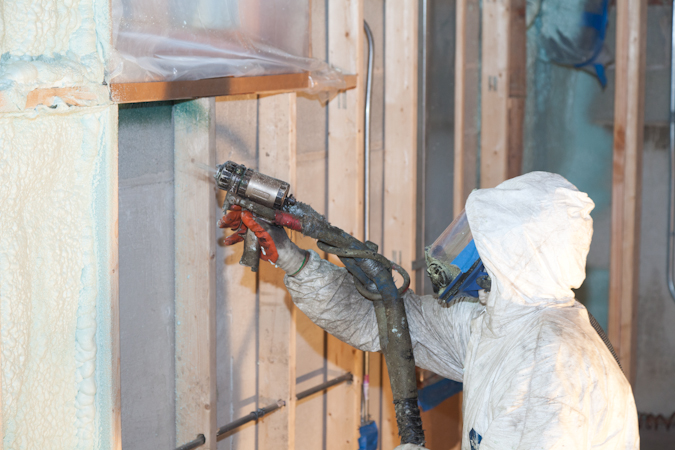
One-component gun foam for air sealing is open-cell: after curing, the cell structure is permeable to moisture vapour. This is acceptable for locations that are covered by the air barrier membrane or are otherwise within the conditioned building volume. Closed-cell two-component spray polyurethane foam (ccSPF) is used where an impermeable insulation layer is also required — for instance, at rim joists, under-slab applications, or exterior walls in climate zones where condensation management requires a vapour-impermeable layer at a specific position in the assembly.
Closed-cell foam at typical application thickness of 50–75 mm has a permeability in the Class II vapour retarder range, which affects where in an assembly it can be positioned relative to the dew point. This requires attention to wall assembly design and local climate zone.
Material Comparison Summary
| Material | Typical Use | Key Consideration |
|---|---|---|
| Acrylic tape | Sheathing seams, poly membrane laps | Requires min. application temperature; cold can reduce adhesion |
| Butyl tape | Transitions, concrete, foil-faced surfaces | Good cold-temp flexibility; can creep under sustained load |
| Compressible gasket | Sill plates, top plates, electrical boxes | Does not rely on adhesion; requires correct compression at install |
| Low-expansion foam | Window/door rough openings, pipe penetrations | Use low-expansion only around window frames to prevent distortion |
| Closed-cell ccSPF | Rim joists, complex junctions, exterior walls | Vapour-impermeable; assembly positioning requires dew-point analysis |